
Though Georgia is popping up more and more in international travel publications, people still want to know more about this Eastern European destination and one of the top points on their minds is their budget.
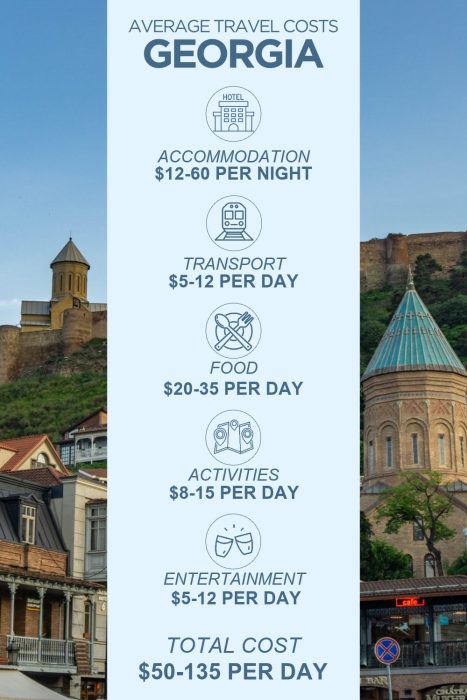
The good news is that Georgia is not an expensive destination and can be considered one of the cheapest in Europe, with an average trip cost of $50-135 USD per person per day.
Michael and I have spent many years both travelling and living in Georgia, so our concept of prices comes 100% from first-hand experience. And we’ve found it to be one of the most affordable places to visit in Europe.
Table of Contents
Georgia Cost Guide
It is worth noting that certain areas of Georgia may be more or less expensive than others. For instance, a small village will likely be less expensive than Tbilisi. And Batumi – especially in the summer months – ends up the most expensive destination in the summer.
This outline is best suited for a budget to mid-range traveller, meaning there are some ways where you can cut costs further and there certainly are ways that you can spend more.
The local currency is the Georgian Lari (GEL), however, all prices in this article are listed in US Dollars. If you would like to see the current exchange rate in your home currency, we recommend xe.com.
Accommodation Prices
Like most everywhere in Europe, your cheapest option for accommodation in Georgia is going to be a dorm bed in a backpacker hostel.
And while there is certainly a developed hostel scene in Tbilisi and lesser still in cities like Kutaisi and Batumi, traditional hostels that backpackers might be used to can be hard to come by outside of these cities.
Nevertheless, expect a bed in a hostel dorm to start at around $10 depending on the size of the room, the location of the hostel, and the amenities offered.
One of the most popular options for budget travellers in Georgia are guesthouses, which are often incredibly affordable and run by local families so you can get a great immersion into the culture and experience some of the famous hospitality.
Guesthouses usually offer private rooms and are a great option for couples or solo travellers looking for a bit more privacy than a hostel dorm.
They can offer either a shared bathroom or an en suite, with the latter option usually resulting in a higher price tag. On average, expect to pay about $20-40 per night for a room in a guesthouse.

Oftentimes, guesthouses will also either include meals or offer them at incredibly discounted rates. We would always recommend adding a breakfast option (usually around $5 per person) as they are usually incredibly hearty and it’s a good way to save money and fuel up for the day.
If you’re offered an opportunity to add dinner, as well, take it – some of our best memories come from enjoying a homecooked meal at a local guesthouse.
Usually, it will cost around $5-10 per person and we have always been offered far more food than any reasonable person could eat. It is an incredible value for money and a great way to sample some truly local cuisine.
If you would rather stay in a traditional hotel rather than a guesthouse or hostel, expect fewer homelike amenities and a higher price tag. Most mid-range hotels outside of Tbilisi will start at around $30-40 per night for a double room with an en suite bathroom.
In Tbilisi (and Batumi in July and August), a mid-range hotel is likely going to be closer to $40-70 per night, depending on the location and the season. If you want to stay in a luxury hotel in Tbilisi, especially in the high season, you will likely be spending around $100-130 per night.
If you’re staying in a city like Tbilisi or Batumi, then Airbnb can also be a good option. There are numerous properties available on the platform ranging from private rooms to fully equipped apartments, however, options can be scarce outside of the cities. Expect a one-bedroom apartment in a central area of Tbilisi such as this to start at around $50 per night.

Transportation Prices
Georgia is well-connected by public transport and it is easy to get to all corners of the country at fairly affordable prices. The most common and affordable way to do this is by mini-bus, also called a marshrutka. These little buses connect cities and towns throughout Georgia and very affordable prices.
Marshrutky tend to only leave when completely full, however, we have never seen an overpacked minibus in Georgia (just ones that are filled to capacity) and they are not as uncomfortable as many would have you believe. For the price, you can’t expect luxury.
Depending on the length of the journey, the prices will vary. For a 90-minute ride, like from Tbilisi to Sighnaghi, expect to pay around $4 per person. For longer rides, like from Kutaisi to Tbilisi, expect to pay about $8-15 depending on the length of the journey.
If you don’t want to be crammed into a marshrutka, then taxis are also an option for transport, albeit a more expensive one. You will almost always find a taxi driver at the bus station who will offer to take you directly to your destination and, generally speaking, you expect to pay about 1 GEL per kilometre for a taxi journey. That works out to be about $0.35 per kilometre.
Ordinarily, you have the option to wait for more passengers looking to go on the same journey to share the taxi with you, in which case, the total journey cost will be cheaper.
Some trains exist in Georgia, but the network isn’t all that developed and it really only connects absolute major cities. You can take the train between Tbilisi, Batumi, Zugdidi, and Kutaisi for affordable prices.

Renting a car is also a popular option for visitors and it gives them a lot of flexibility. It can also be a good choice if you’re pressed for time and want to see as much as possible without being beholden to erratic bus timetables. However, car hire prices in Georgia can be just as expensive as in Western Europe and it can add significantly to your overall trip cost.
You can also rent cars directly from locals using LocalRent which will typically be a cheaper option, though vehicles will likely not be as new.
For those who don’t want to drive themselves but also can’t be bothered dealing with the public transit “system” in Georgia, hiring a private driver can be your best option – and it’s not going to absolutely break the bank.
Expect a typical journey to average around $50 depending on where you go and the distance you travel – and this is for the vehicle, not per person.
If you are splitting costs, your per-person cost will go down significantly. You can easily book drivers on GoTrip, or you can often find drivers willing to take you wherever you’d like to go at any bus station.
In Tbilisi, you may also have to rely on some form of public transportation or taxis if you want to get the most out of the city. The capital is well connected with an affordable metro system — it requires the use of a transit card (a one-off 2 GEL fee) and each subsequent journey costs 1 GEL or about $0.35.
Taxis are also affordable and you will rarely need to pay more than about $3-5 to get around the city centre. If you want to save yourself the hassle of negotiating a fare from a taxi off the street, then we recommend using an app like Bolt to hail a cab. This will give you the exact fare before riding and you can pay the driver in cash upon arrival.

Food Prices
It is possible to eat well on an incredibly tight budget (less than about $20 per day if you spend wisely!). If you find accommodation that offers breakfast, that can cut down considerably on your food costs.
Pop into a bakery for lunch and fill up on a lobiani (bean-filled bread) or khachapuri (cheese-filled bread) for $2-3. For dinner, you can find a budget-friendly restaurant popular with locals and it’s likely that you won’t spend more than $10 in total for a meal.

In all likelihood, however, you will want to sample more of the fantastic restaurants in Georgia and you won’t always be able to — or want to — stick to such a tight food budget. However, you will find that it is also entirely possible to spend less than $15-20 per person even at a mid-range restaurant.
Even at the fanciest and most expensive restaurants in Tbilisi, your final bill will be a fraction of what a comparable meal in Western Europe would cost.
As mentioned in the accommodation section above, many guesthouses will also offer meals as an option. We always recommend taking advantage of a breakfast option even if it isn’t included in the room rate because, more often than not, it will be fantastic value for money.

Activity Prices
It is popular to go on day tours in Georgia, especially if you’re pressed for time and you want to visit a number of sites in one day that are hard to get to by public transport.
And while there are certainly some day trips that are easy enough to organise independently such as from Tbilisi to Mtskheta or to Kazbegi, it can be a huge convenience to find a day tour to some of the more difficult-to-reach areas.
The cheapest option for this would be to book a group tour, where it is likely that you will only have to pay around $35 per person depending on what is included.

Sometimes, you are only paying for the transport to the various sites and not the entry within, and sometimes everything is included in one price. Make sure you verify what is included before you book and know approximately what extras you will have to account for.
Many guesthouses will organise day tours for their guests to see the surrounding area, as well. Here, often a family member or a friend will drive you around and you will pay for the price of the car.
The more people you can get to come with you, the cheaper it will be for everyone. For a full-day tour (not including entry fees) with a private driver, expect the car to cost around $75. If you manage to get four people to go on the tour with you, that is only $18 per person.
When it comes to general sightseeing and entry into attractions, fees aren’t typically high. Museum entry fees tend to be about $5, and the same goes for other attractions. Cathedrals and monasteries are almost always free to enter (we have never encountered one that has charged an entrance fee except to climb the towers).

Entertainment Prices
Well, like most everything else, it doesn’t have to cost much! Keen to see the ballet in Tbilisi? Well, some of the top seats in the gorgeous Tbilisi Opera Theatre will only cost about $30 — and that is about the most expensive it gets.
You can get tickets for as little as $5, and this pricing structure is on par with most performing arts venues across the country.
If you like to go out for the occasional drink, it doesn’t have to be expensive in Georgia at all — especially if you stick to local products. If you find yourself in a local wine cellar where they make their own reds and whites, expect a litre of wine to cost less than $5.
A shot of local chacha (Georgia’s response to grappa) can be less than $1 and so can a glass of some homemade Georgian wines.
If you want to get a glass of a fine wine, expect to pay a little bit more. Bottled wines are typically produced for foreigners as locals tend to only like to drink the homemade stuff, however, you will likely not pay more than $5 for this, and that is for a very pricey one. A bottle of fine wine will cost closer to $10-12.

Average Georgia Trip Cost
All the above factors considered this a breakdown of how much an average trip to Georgia will cost per person per day. As mentioned earlier, this is following a low- to mid-range budget — accounting for the occasional splurge while staying in guesthouses and not eating every single meal out.
Accommodation: $12-60 / night
Transportation: $5-12 / day
Food: $20-35 / day
Activities: $8-15 / day
Entertainment: $5-12 / day
In total, expect your daily average cost to be about $50-135 per person per day. There are certainly ways that you can cut things down more and the upper end includes spending nights in high-end hotels for the entirety of your trip.

Your total trip cost does not have to break the bank in the slightest and you can live very well in this beautiful nation on a shoestring budget.
Are you visiting Georgia? Have any questions? Let us know in the comments!


Good information thanks